Scientists at the US Geological Survey just announced on Friday that they have received five-million dollars to purchase 100 new seismic stations to place throughout SoCal, and to provide for computer processing space. This step will be crucial for creation of an earthquake early warning system, by decreasing the "blind zone," or region that would not receive alerts in the event of a large earthquake.
Los Angeles Mayor Anotonio Villaragiosa stated to the press that, "Our system will be more capable of providing fast, easily understood and actionable warnings that could save lives when the Big One hits."
Here is a video of a Shinkansen train slowing to a stop during a 7.1 earthquake in Japan last year. Imagine what could have happened without the earthquake early warning system in Japan.
Finally, this month, state senator Alex Padilla introduced a bill to hopefully fund an Earthquake Early Warning System for California. Although many may criticize the system, saying that $80 million dollars can be spent for other important purposes, I believe that this is very small price to pay for a system that can protect valuable infrastructure from billions of dollars of damage.
Earthquake Early Warning in Japan has saved a countless amount of money in sensitive infrastructure since its deployment in October 2007. For example, during the Tohoku Earthquake and Tsunami in 2011 not a single high-speed bullet train in the entire Tohoku Region derailed because of the automatic braking system that kicks when an Earthquake Early Warning is issued. Millions throughout the region were alerted up to a minute before the earthquake that it was coming, when their smart-phones buzzed with the Earthquake Early Warning tone.
NTT Docomo's "Area Mail" with the obvious EEW tone.
This video (stabilized) shows the 3-11 earthquake with the NTT docomo "Area Mail" tone.
This video shows the performance of EEW (On NHK TV) during the Iwate-Miyagi Nairiku Earthquake in 2008, the strongest earthquake after EEW's deployment before the 2011 Tohoku Earthquake.
An instructional video on EEW.
EEW and Tsunami Warning Japan on 12-7-12
This video shows a simulation of a large earthquake in Honshu.
In Southern California, in the event of a large earthquake on the San Andreas Fault, up to a minute of warning would be possible if the system were in place.
This post has been replaced by A Background on Earthquake Early Warnings, found in the tabs at the top of the page.
Since the time earthquake monitoring began, scientists have wondered
if earthquake prediction is possible. Some scientists attempted to link
earthquakes with previous seismic activity, radon emissions, changes in the magnetic field and animal behavior. None of these earthquake
“prediction” attempts were successful.
The QuakeGuard Warning System
In the
1990’s, a commercial group began producing QuakeGuard Seismic Warning Systems
that use a seismometer placed under a location that detects the harmless, fast
moving primary waves of an earthquake, that arrive before more damaging S and Surface waves. The system then alerts the user by setting off an alarm, and
sometimes even shutting off the gas supply before the arrival of the damaging
Surface waves. QuakeGuard was the first operational version of an earthquake
early warning system that was able to alert users tens of seconds ahead of a
large earthquake, with no false positives.
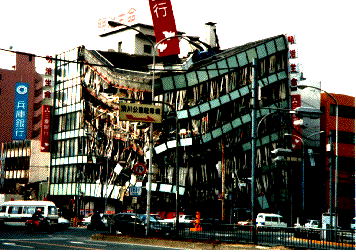
Kobe Earthquake Damage
In the 1990's seismologists in Mexico City created a simple earthquake early warning system that involved seismometers placed on a fault off the coast. When shaking was detected by the seismometers, sirens in the city would sound, giving precious seconds to evacuate un-reinforced buildings.
On
January 17, 1995 at 5:46am (Japan Standard Time), a 6.8 magnitude earthquake
struck Kobe, the capital of Hyogo Prefecture in Japan. The quake killed over
140,000 people and caused about 100 billion dollars in damages.
Following the quake Japan started work on a nation-wide
earthquake early warning system to help save lives in the event of another
major earthquake. This system implemented 4,235 seismometers throughout the
country to estimate the intensity of an earthquake and to deliver an early
warning to all of its users in the affected areas. The system was first implemented
to slow down bullet trains and finally, on October 1, 2007, was put into place
nationally. It was ready to alert millions through text messages, TV
alerts, radio broadcasts, sirens, and government approved Earthquake Early
Warning compatible products.
The system proved its usefulness when on March 11, 2011 at
2:46pm (Japan Standard Time); a 9.0 megathrust earthquake struck its coast.
Eight seconds after the earthquake began, seismometers offshore Miyagi
Prefecture recognized the fastest moving (P) waves of earthquake and
immediately sent earthquake early warnings to the Tohoku Region of Japan. Earthquake early warning messages interrupted radio
and TV broadcasts automatically. Two sets of computer generated chimes rang,
followed by a prerecorded announcement of a man saying the following, “緊急地震速報です。強い揺れに警戒して下さい。 (Kinkyu
jishin sokuho desu. Tsuyoi yure ni kekai shite kudasai.)” Translated, the passage reads, “This
is an earthquake early warning. Please prepare for powerful tremors.” Although
the city of Tokyo received up to a minute of warning time, in Sendai (closest
to the epicenter) the warning was only fifteen seconds. Although fifteen seconds may not seem like much time, five
seconds is a sufficient amount of time to duck and cover under a sturdy desk. Few
people died in the earthquake’s shaking, proving the system’s effectiveness. Unfortunately
the tsunami that followed killed 15,845 people with 3,380 people still missing,
creating a need for larger seawalls and more efficient tsunami warnings.
Seismologists from
Caltech, USGS Pasadena, USGS Menlo Park, and UC Berkeley, have teamed together
with the California Integrated Seismic Network to create and perfect an
earthquake early warning system for California, and later for the entire United
States Pacific Coast. In 2011 a rough earthquake early warning system was
created, and is currently being tested by selected seismologists, the Bay Area
Rapid Transit System, and other companies and government organizations
throughout California.
Like most functioning systems, there are some issues:
1. Point Source Approximation. The system is only able to perceive that an earthquake radiates from one point, not a rupture along a fault line. 2. Seismometer spacing. There are few seismometers along the Central California and Northern California Coast to
detect earthquakes quickly. Seismometer spacing must be reduced to 12 miles apart from each other.
3. Funding. A system along the West Coast
would cost approximately one-hundred and fifty-million dollars over five years to perfect, and several million dollars more per year to fund.
On November 29, 2012 the Gordon and Betty Moore
Foundation provided a 6 million dollar grant to help fund the Earthquake Early
Warning System. Although a system would cost over
$150,000,000, it would, in the long run, lessen costs of damages by earthquakes, by stopping production lines, and other sensitive industries, and will reduce personal injury caused by falling debris.
Update: 1/29/13 In January 2013 a bill was created to possibly fund an $80 million dollar earthquake early warning system for California.
Earthquake Early
Warnings have saved lives in many earthquake prone countries over the past few
years. Unfortunately it often takes the loss of thousands of lives to fund such
a system. Hopefully, a system will be publicly implemented on the West Coast of
the United States without another devastating earthquake to catapult its creation.